Ukraine: Friends and Funerals
Despite talk of a ceasefire with Russia, some people in Ukraine expect conflict to continue in some form beyond any near-term deal. Here's a story about the war and a few young men.

It was the Orthodox Christmas season in wartime.
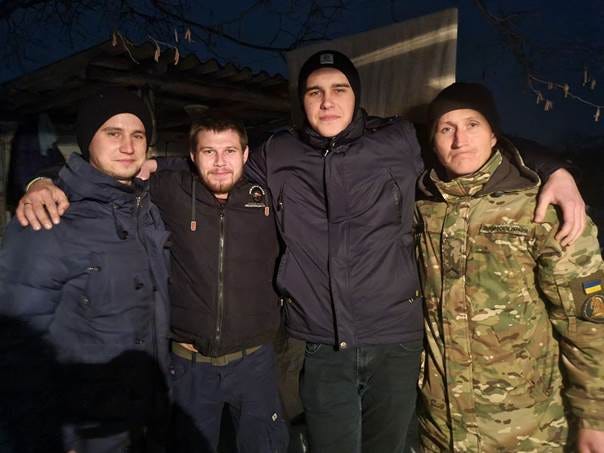
On January 7, 2023, four young men - old friends - had dinner in Romanivka, a Ukrainian village where they used to spend time together. They stepped outside for a smoke and posed for a photograph.
The friends stand side by side, looking into the smartphone camera lens. Three have hints of a smile. The pursed lips of the fourth are hard to read.
From the left, there is Oleksandr Semenyuk, a construction worker in his mid-20s; then bearded, bareheaded Petro Osadchuk, around the same age, a soldier right out of school who had fought in the contested Donetsk region before Russia’s full-scale invasion of Ukraine in 2022; then Yehor Koziakov, a university student and the youngest of the group at 20 years old. Those three are distant cousins.
Koziakov, the tallest, comfortably clasps his friends with outstretched arms. He is the godfather of the daughter of the man without a smile at far right, Mykhailo Polishchuk.
Polishchuk, a former builder in his early 30s, wears camouflage, Ukraine’s blue and yellow national colors on his arm. He is especially close to Semenyuk, becoming a mentor after the younger man’s father faded from his life.
The photographer is Olya Osadchuk, Petro’s wife.
Intertwined lives.
“I don’t cry at funerals but sometimes I feel that my eyes are getting full of tears. I try to manage it. Mostly, I feel nothing… That’s really bad but maybe something inside of me became less emotive to the information or maybe I developed some kind of coping mechanism without realizing it.”
Koziakov, who turns 23 in August 2025, seemed impassive when he talked about death in the war against Russia during a dinner conversation with me in Ukraine this year. We were speaking for the first time. Later, during phone conversations after I left Ukraine, the young man reflected on the strain of hearing about the death of people he knows and the sorrow that rushes in like a wave and recedes.
“It hits very hard every time when you hear about it,” he said. At the same time, he’s used to it: “I think that it´s psychologically impossible to be compassionate each time.”
Many Ukrainians are more numb to violent death, some men are avoiding military conscription and an early optimism and energy has faded. But people raise funds, donate blood, help each other and even pets caught in the war. Koziakov has sourced gasoline and building materials for the military units of a couple of friends through a volunteer network.
“We are trying to talk to each other, at least understand each other and we are trying to get through all of these difficulties that keep accruing in our lives,” said Koziakov, who plans to graduate this year with a degree in private international law from Taras Shevchenko National University in Kyiv.
What comes next?
--
“It’s a really complicated issue for me because I wouldn’t be against the government enlisting me tomorrow or something like that, because I don’t have this fear of service in the army like some Ukrainian men. I wanted to go to the front lines like a volunteer, like many of my friends did. But I had all of these hard conversations with my family,” said Koziakov, who by law would not have to join the military until he is 25 years old. “I just cannot cross this line of my family because it’s really hard to realize that my mother and father, they wouldn’t be able to sleep at least for some time. Just because of that, I cannot make a final decision. So it’s a little bit postponed.”
Meanwhile, he is getting ready for war – military cadet training and combat medic courses, and practicing on a drone simulator game at home after a brief course on drone warfare.
--
This combatant in waiting studies commentaries of Russian military bloggers and doesn’t underestimate the enemy.
He has complex feelings about Russia, which has inflicted mass casualties on Ukrainian civilians with missile and drone strikes on cities and towns. Ukrainian and international investigators have gathered evidence of executions and torture in areas where Russian troops operated; Russia says it’s all a hoax.
“Obviously, there is hate. But it’s like cold hate,” Koziakov said. He defined it as not anger or “bright emotions,” more sadness and “all of these negative emotions, but they don’t burn.”
The young man doesn’t want Ukraine to engage in the kind of war crimes that Russian troops are alleged to have carried out many times. But he has no empathy for Russian civilians.
“I want them to feel this pain and all this suffering that the Ukrainian people have gone through,” Koziakov said.
I asked: But to feel that pain, wouldn’t Russian civilians have to experience what Ukrainian civilians have experienced? He acknowledged the conundrum.
--
The first funeral for a friend killed in combat was in March 2023.
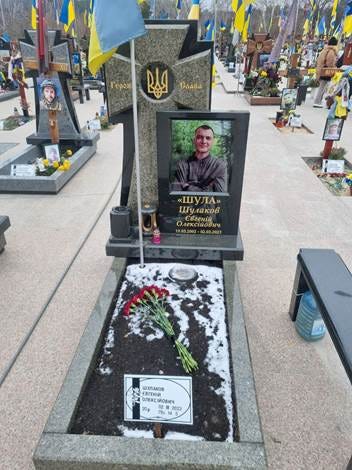
Yevheniy Shulakov was 20 years old when he died in Bakhmut, which Russian forces later seized after fighting that virtually destroyed the eastern Ukrainian city.
Shulakov and Koziakov studied together for nearly 10 years, until their mid-teens. The funeral happened in Kyiv, near their old school. Teachers, soldiers and family members attended. A military band played and a priest presided. Earlier this year, Koziakov brought flowers to Shulakov’s grave. He left a lit cigarette, a military mourning tradition.
The last funeral that Koziakov attended was this past February for 21-year-old Matviy Volobuyev, who worked in military intelligence. It was a big event because there were services for several other soldiers at the same time in St. Volodymyr's Cathedral, a 19th century landmark in the center of Kyiv.
--
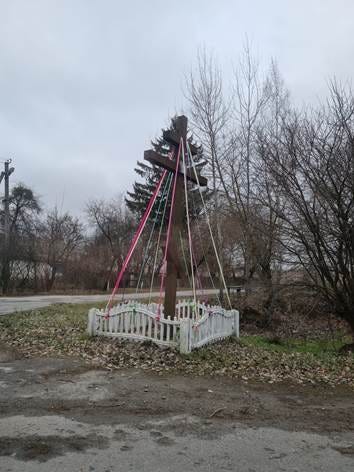
Romanivka, the village where the four friends met for Christmas dinner, lies 200 kilometers west of the wide avenues and varied architecture of the capital. Most young people have left for the cities, but a few hundred people still live there. There's a church, a small library, a club, a clinic, a woodworking factory. Most households have some livestock. They use wood stoves to keep warm in the winter.
The village is in Zhytomyr region (there are several Romanivkas in different parts of Ukraine). It is a 10-15 minute drive from the city of Zviahel, where Valerii Zaluzhnyi, the former military commander and current ambassador to Britain, was born. In wartime, Romanivka residents are particularly proud to be near his birthplace. One of Ukraine’s most prominent writers, Lesya Ukrainka, was born there in 1871.
Zviahel was known in Russian imperial and Soviet times as Novograd-Volynsky, but the city restored its original name in 2022.
--
In 2023, Ukraine changed official Christmas celebrations to Dec. 25 to get away from Russian Orthodox influences. But that was after the four young men marked the Orthodox Christmas in Romanivka, where they drank gin cocktails and ate dishes such as kutya, a pudding usually containing honey, berries and poppy seeds that is served in the Christmas season.
Semenyuk and Osadchuk grew up in Romanivka. Koziakov’s mother left there for Kyiv when she was a young woman, and her son spent some school vacations in the village. Those were easygoing times. The boys told jokes, walked around, played cards, drank beer.
At Christmas dinner, the men felt the tension of war, but were buoyed by recent Ukrainian victories.
Before he joined the military, Polishchuk helped rebuild the town of Schastya, which means “good fortune” or “happiness” in Ukrainian, in the eastern region of Luhansk – only to see it shattered by Russian attacks in 2022. Polishchuk’s next frontline deployment was approaching, and his friends asked if they could get any supplies or equipment for him.
--
Mykhailo Polishchuk was killed while fighting in Russia’s Kursk region in October 2024.
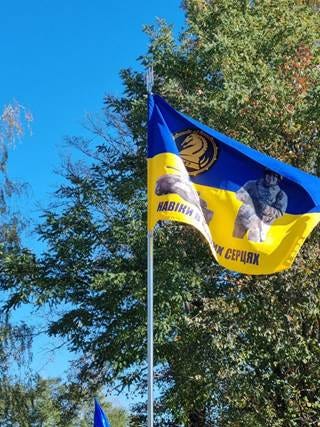
The area where he died was under Russian shelling and it took one to two weeks to evacuate his body. Because of the decomposition, the coffin was closed during the funeral in Romanivka. Usually, funerals in Ukraine are open casket.
Koziakov went to the morgue and joined relatives who hired a truck to carry the coffin as people knelt, put their hands over their hearts and tossed flowers into the road.
Koziakov had participated in the baptism of Polishchuk’s daughter, Sophie. Now he sometimes visits seven-year-old Sophie and her mother, Maryna Polishchuk. He has treated the girl to icecream and a walk in the park.
“Sometimes she mentions him and I try to cheer her up, maybe to share some memories, but usually I don’t initiate this kind of conversation,” Koziakov said.
--
The next funeral, also in Romanivka, was for Petro Osadchuk in December 2024.
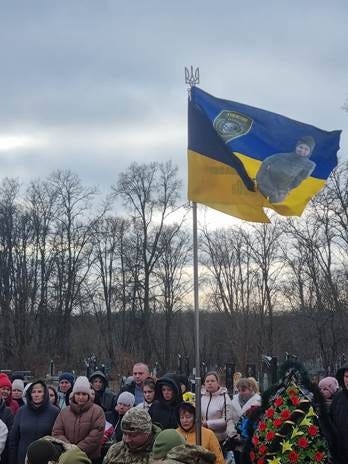
Osadchuk’s wife, Olya, texted Koziakov with the news late at night and he didn’t ask for details.
The graves of Osadchuk and Polishchuk are close to each other. Osadchuk was comfortable with village life. He worked in the fields, chopped firewood, helped his family with the sheep, cows and pigs.
--
Oleksandr Semenyuk was next. Ukrainian military commanders said he was killed when his position was hit with artillery shells and drones in February 2025.
His body hasn’t been recovered from the Donetsk frontline. Soldiers in his unit mailed packages with Semenyuk’s clothes and other personal items to a post office in Kyiv. Koziakov picked them up and remembers thinking: “This is everything that’s left of my friend.”
He delivered the unopened packages to Semenyuk’s girlfriend, Kateryna Bratsyuk.
--
Of the four men in the Christmas photo, three are dead. In a recent dream about his friends, Koziakov faced the future.
“It appeared to me that they were alive, but I realized in my dream that they are dead and that I can do nothing about it. I need to accept it. I need to preserve their memory, my memories of them. I have a sense that I have a lot of responsibilities.”